Surgical Success Does Not End When the Procedure Is Complete
Surgical success does not end when the procedure is complete.
For OB-GYN surgeons, what happens during the healing process can be an important part of the overall surgical journey. Procedures such as hysterectomy, myomectomy, endometriosis excision, ovarian surgery, pelvic reconstruction, and cesarean section can involve tissue dissection, manipulation, surgical incisions, and the creation of new tissue planes.
As these tissues heal, surgeons must consider not only the immediate surgical repair, but also the environment in which healing will occur.
That growing focus on surgical healing has contributed to interest in placental and amniotic tissue allografts as adjuncts in selected OB-GYN procedures.
Why Healing Matters in Gynecologic Surgery
Surgery naturally creates tissue trauma. The body’s healing response begins immediately and involves inflammation, fibrin deposition, cellular activity, extracellular matrix remodeling, and tissue repair.
Within abdominal and pelvic surgery, postoperative adhesion formation is one recognized consequence of surgical tissue trauma and healing.
The American Society for Reproductive Medicine describes postoperative adhesions as a natural consequence of surgical tissue trauma and healing. Pelvic adhesions can potentially contribute to infertility, bowel obstruction, abdominal or pelvic pain, and increased technical difficulty during subsequent surgery.
Good surgical technique remains fundamental. Gentle tissue handling, meticulous hemostasis, limiting tissue ischemia and desiccation, and minimizing unnecessary tissue trauma are among the principles used to reduce surgical injury and support healing.
Increasingly, surgeons may also evaluate adjunctive technologies intended to provide protection to exposed or surgically manipulated tissues during this healing period.

What Are Amniotic Grafts?
Amniotic grafts are human tissue allografts derived from donated placental tissue.
The placenta contains several tissue layers, including the amnion and chorion. Depending on the specific product and processing method, placental allografts may contain a naturally derived extracellular matrix composed of structural and regulatory components.
These allografts are processed into forms that can be used by surgeons as coverings or protective barriers over surgical wounds and exposed tissues.
Rather than replacing good surgical technique, amniotic and placental allografts are used as adjunctive surgical materials when the surgeon determines they are appropriate for the individual patient and procedure.
The Role of the Extracellular Matrix
One reason placental tissue has received considerable attention in surgical applications is its naturally occurring extracellular matrix, or ECM.
The extracellular matrix provides the structural environment surrounding cells within human tissue. It contains proteins and other matrix-associated components involved in normal tissue architecture and biological processes.
Some commercially processed placental allografts are specifically designed to preserve components of this extracellular matrix.
For example, MIMEDX states that its proprietary PURION® processing method used for AMNIOFIX® and AMNIOEFFECT® preserves extracellular matrix components, including hundreds of regulatory proteins.
The resulting allografts are used as protective barriers over wounds and exposed tissues, thereby supporting development of granulation tissue and the healing process.
Amniotic Grafts as a Protective Surgical Barrier
One of the most straightforward ways to understand the potential role of an amniotic graft is as a protective covering over a surgical site.
Following tissue dissection or repair, a surgeon may place an appropriately selected placental allograft over exposed or manipulated tissue.
Depending on the allograft, the material may conform to the surgical anatomy and provide a biologic tissue interface over the wound.
This is different from claiming that every amniotic graft is an FDA-approved adhesion-prevention device.
Traditional adhesion barriers and placental tissue allografts are different product categories, with different indications and regulatory requirements.
For that reason, surgeons should evaluate each product according to its specific Instructions for Use and available clinical evidence.
Where Might Amniotic Grafts Be Considered in OB-GYN Surgery?
The clinical decision to use a placental allograft depends on the procedure, surgical anatomy, patient characteristics, surgeon preference, product labeling, and institutional requirements.
Several areas of gynecologic surgery involve substantial tissue manipulation or exposed surgical surfaces and may prompt surgeons to consider adjunctive tissue protection.
Hysterectomy
Hysterectomy may involve extensive dissection within the pelvis as the uterus is separated from surrounding supporting structures and tissues.
Depending on the surgical approach and individual case, surgeons may encounter areas of exposed or manipulated tissue where protecting the surgical site during healing is a consideration.
Placental allografts are among the biologic technologies being used by some surgeons as protective barriers in hysterectomy procedures.
Myomectomy
Myomectomy involves the surgical removal of uterine fibroids while preserving the uterus.
Depending on the number, size, and location of the fibroids, the procedure may require one or multiple uterine incisions followed by reconstruction of the uterine tissue.
Because tissue preservation and healing are particularly important in these procedures, myomectomy has become one area where surgeons have explored the use of placental tissue allografts as surgical adjuncts.
MIMEDX currently lists myomectomy among clinical-use examples for AMNIOFIX.
Endometriosis Excision
Surgical treatment of endometriosis can involve extensive dissection and removal of abnormal tissue from multiple areas of the pelvis.
Depending on disease severity, surgery may involve tissues surrounding the uterus, ovaries, fallopian tubes, pelvic sidewall, bladder, bowel, or other structures.
This can leave broad areas of surgically manipulated or exposed tissue.
MIMEDX currently identifies endometriosis surgery as one of the clinical applications in which AMNIOEFFECT has been used as an onlay allograft to cover and protect exposed tissue.
Ovarian Surgery
Procedures involving ovarian cysts, endometriomas, or other ovarian pathology frequently require careful dissection intended to remove abnormal tissue while preserving healthy ovarian tissue whenever clinically appropriate.
This makes the quality of the surgical repair and subsequent healing environment particularly relevant.
MIMEDX has demonstrated the application of AMNIOFIX following robotic ovarian cyst removal as an example of placental allograft use in gynecologic surgery.
Pelvic Reconstruction
Pelvic reconstructive procedures may involve multiple tissue planes and surgical repairs intended to restore pelvic anatomy and function.
Because of the complexity of these surgical sites, surgeons may consider adjunctive technologies that can provide additional coverage and protection to selected exposed tissues.
The appropriate use of any biologic material depends on the particular procedure, product labeling, and the surgeon’s clinical judgment.
Cesarean Section
Cesarean delivery involves surgical incisions through the abdominal wall and uterus followed by repair and healing of multiple tissue layers.
As interest in regenerative and biologic surgical technologies continues to grow, placental tissue allografts are also being evaluated across a broad range of surgical specialties and procedures.
Any use in cesarean section should be based on the specific allograft’s Instructions for Use, available evidence, institutional policies, and the treating physician’s clinical judgment.
Amniotic Grafts and Adhesion Concerns
Postoperative adhesions have long been an important consideration in abdominal and gynecologic surgery.
Adhesions can form when injured tissue surfaces heal in contact with one another. The process begins shortly after tissue injury and can progress as fibrin, fibroblasts, blood vessels, and other components become involved in the healing response.
Traditional products specifically indicated for adhesion reduction generally work by physically separating adjacent tissue surfaces during a critical portion of the healing period.
Placental tissue allografts should not automatically be considered equivalent to an FDA-cleared or approved adhesion barrier simply because they may be placed over exposed tissue.
That distinction matters.
While the characteristics of amniotic tissue make these grafts interesting surgical adjuncts, product-specific claims should always be based on the manufacturer’s labeling and supporting clinical evidence.
The Evolution Toward Biologic Surgical Adjuncts
For decades, surgeons have used various materials to protect tissues, reinforce repairs, separate tissue surfaces, and support challenging surgical sites.
The emergence of placental tissue allografts represents another step in that evolution.
Instead of relying exclusively on synthetic or manufactured materials, surgeons now have access to human-derived extracellular matrix technologies designed for use as protective barriers over wounds and exposed tissues.
Modern placental allografts are also available in multiple sizes, thicknesses, and configurations, allowing surgeons to select materials according to the anatomy and requirements of the procedure.
For minimally invasive and robotic surgery, handling characteristics can also be important because a graft may need to pass through a trocar, unfold within the surgical field, conform to irregular anatomy, or be secured in place.
Placental Allografts Used in Gynecologic Surgery
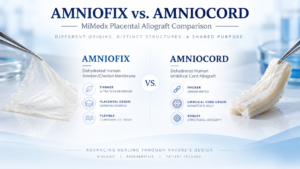
MIMEDX offers several placental tissue allografts used across surgical specialties, including AMNIOFIX®, AMNIOEFFECT®, and AMNIOCORD®.
AMNIOFIX is a dehydrated human amnion/chorion membrane allograft designed to provide a protective barrier over surgical wounds.
AMNIOEFFECT is a thicker, tri-layer placental allograft consisting of human amnion, intermediate layer, and chorion. Its thickness allows the graft to be sutured when appropriate, and MIMEDX identifies both hysterectomy and endometriosis surgery among its clinical-use examples.
The selection of graft type and size ultimately depends on the surgical application and physician preference.
The Bigger Picture: Supporting Healing Beyond the Procedure
Advances in surgical technology have dramatically changed how many gynecologic procedures are performed.
Robotic platforms, minimally invasive techniques, advanced energy systems, imaging, and improved instrumentation have allowed surgeons to perform increasingly complex procedures through smaller approaches.
The next frontier is increasingly focused on what happens after the surgical repair is complete.
How can the surgical environment best support tissue protection and healing?
That question is helping drive growing interest in biologic surgical technologies, including placental and amniotic tissue allografts.
The goal is not to replace meticulous surgical technique.
It is to give surgeons additional tools when they believe a biologic tissue covering may be appropriate for the surgical site and patient.
Conclusion
OB-GYN surgery often involves delicate anatomy, significant tissue manipulation, and surgical sites where the quality of healing matters.
Placental and amniotic tissue allografts provide surgeons with another potential tool for protecting exposed tissues and supporting the surgical healing environment.
Products such as AMNIOFIX and AMNIOEFFECT demonstrate how placental tissue technologies are increasingly being incorporated into procedures including hysterectomy, myomectomy, endometriosis surgery, and ovarian surgery.
As the field of surgical biologics continues to evolve, understanding the science, appropriate applications, and limitations of these technologies will become increasingly important for surgeons and healthcare organizations evaluating new approaches to surgical healing.
About 6|Sixty
6|Sixty is a surgical biologics specialist focused on connecting surgeons and healthcare organizations with advanced biologic technologies designed to support surgical healing and patient care.
To learn more about surgical biologics and available educational resources, visit 6Sixty.com.
This article is provided for educational purposes only and is not intended to provide medical advice or substitute for a healthcare professional’s clinical judgment. Product use should be consistent with applicable Instructions for Use, institutional policies, and regulatory requirements.