Surgery has traditionally focused on anatomy, technique, fixation, reconstruction, and mechanical repair.
Today, another dimension is becoming increasingly important: the biological environment surrounding surgical healing.
That is where surgical biologics come in.
Surgical biologics are biologically derived materials and technologies used during or around surgical procedures to support tissue management, repair, reconstruction, protection, or healing. Depending on the technology, they may be derived from human tissue, extracellular matrix, collagen, bone, placental tissue, or other biologic sources.
The field includes a wide range of products — from amniotic grafts and placental tissue allografts to extracellular matrix technologies, collagen-based materials, bone graft products, and other tissue-derived solutions.
As biologic technologies continue to evolve, surgeons across multiple specialties are gaining access to a broader range of tools designed for the surgical environment.
What Are Surgical Biologics?
The term surgical biologics broadly describes biologically derived products used as part of surgical care.
Unlike traditional implants made primarily from metal, polymer, or other synthetic materials, biologic technologies incorporate tissues, proteins, extracellular matrix components, or other biologically derived materials.
Different surgical biologics may serve very different purposes.
Depending on the product and its labeling, biologic technologies may be used as:
- Tissue barriers
- Scaffolds
- Allografts
- Extracellular matrix materials
- Bone graft materials
- Collagen-based technologies
- Tissue-replacement or tissue-support products
- Other biologically derived surgical adjuncts
There is no single product that defines the category.
Instead, surgical biologics represent a broad and evolving collection of technologies designed for use within the biological environment of surgery.
Why Are Biologics Becoming More Important in Surgery?
Modern surgery is extraordinarily effective at repairing anatomy.
A surgeon can remove damaged tissue, reconstruct anatomy, repair a tendon, fuse a spine, reconnect bowel, close an incision, implant a joint, or remove disease.
But the surgical procedure itself is only part of the process.
After surgery, the body must still respond biologically.
That process can involve:
- Inflammation
- Tissue remodeling
- Extracellular matrix formation
- Vascularization
- Scar formation
- Fibrosis
- Adhesion formation
- Cellular signaling
- Tissue integration
- Wound healing
This has created growing interest in technologies that interact with or support the surgical healing environment.
Surgical biologics are one response to that challenge.
Rather than focusing only on mechanical reconstruction, biologic technologies introduce materials designed to function within the tissue environment surrounding surgical repair.
The Surgical Biologics Landscape
The surgical biologics category includes several major technology groups.
INSERT SECOND IMAGE HERE

The surgical biologics landscape includes placental tissue allografts, extracellular matrix technologies, collagen-based technologies, orthobiologics, and other biologically derived surgical materials.
Placental Tissue Allografts
One increasingly visible category of surgical biologics is placental tissue allografts.
These products are manufactured from donated human birth tissue, which can include:
- Amnion
- Chorion
- Intermediate placental tissue layers
- Umbilical cord
- Other placental tissue components
Products derived from amnion or amnion/chorion are often referred to broadly as amniotic grafts.
Placental tissue has a complex extracellular matrix and naturally occurring structural components that have made it an area of research and clinical interest across multiple surgical specialties.
Commercial placental allografts can differ substantially in:
- Tissue composition
- Thickness
- Processing
- Preservation
- Sterilization
- Storage
- Handling
- Available dimensions
- Intended use
- Supporting clinical evidence
That means the phrase “amniotic graft” describes a category rather than a single standardized technology.
MiMedx and Placental Surgical Biologics
One of the best-known companies in the placental tissue field is MiMedx Group, Inc.
MiMedx develops and commercializes placental tissue allografts for wound care and surgical applications.
Within its surgical portfolio are products such as AMNIOFIX® and AMNIOEFFECT®.
AMNIOFIX
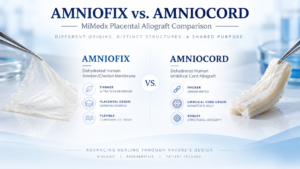
AMNIOFIX is a MiMedx placental tissue allograft composed of dehydrated human amnion/chorion membrane, commonly abbreviated DHACM.
MiMedx describes AMNIOFIX as providing a protective barrier on surgical wounds.
AMNIOEFFECT
AMNIOEFFECT is a thicker placental tissue allograft composed of:
- Amnion
- Intermediate layer
- Chorion
MiMedx describes AMNIOEFFECT as providing a protective barrier on surgical wounds and exposed tissues.
The differences between products such as AMNIOFIX and AMNIOEFFECT illustrate an important concept within surgical biologics:
Biologic source alone does not define the product.
Processing, tissue composition, configuration, thickness, handling, preservation, and intended use can all meaningfully differentiate one biologic technology from another.
Extracellular Matrix Technologies
Another important category involves extracellular matrix, often abbreviated ECM.
Extracellular matrix is the structural network surrounding cells within biological tissues.
It can include components such as:
- Collagen
- Proteoglycans
- Glycoproteins
- Structural proteins
- Other matrix-associated molecules
Certain surgical technologies are developed from processed or decellularized tissues intended to retain portions of this structural matrix.
Depending on the product, extracellular matrix technologies may be used as scaffolds, tissue-support materials, or other surgical adjuncts.
ECM technologies can originate from human tissue or animal-derived tissue depending on the specific product.
As with placental allografts, processing methods matter because they can influence the final structure and characteristics of the material.
Collagen-Based Surgical Technologies
Collagen is one of the body’s major structural proteins and plays an important role in connective tissue.
Because of those characteristics, collagen-based technologies have been developed for a wide range of surgical applications.
These products may be used in forms such as:
- Powders
- Sheets
- Matrices
- Sponges
- Membranes
- Flowable materials
- Combination products
Depending on their design and labeling, collagen technologies may be used for purposes involving tissue support, wound management, hemostasis, scaffolding, or other surgical applications.
Collagen may be derived from human or animal sources and processed in substantially different ways depending on the manufacturer and intended use.
Bone Grafts and Orthobiologics
Some of the longest-established surgical biologics are found in orthopedics and spine surgery.
Bone graft and orthobiologic technologies can include:
- Autograft
- Allograft bone
- Demineralized bone matrix
- Mineralized bone grafts
- Synthetic bone graft substitutes
- Biologic composites
- Other products designed to support bone-related surgical applications
These technologies are commonly encountered in procedures involving:
- Spine fusion
- Trauma
- Joint reconstruction
- Foot and ankle surgery
- Dental and maxillofacial procedures
- Other orthopedic applications
Orthobiologics represent a large category of their own, but they also demonstrate how broad the overall surgical biologics landscape has become.
Other Tissue-Derived Technologies
Surgical biologics extend beyond placental tissue, collagen, and bone.
Other categories may include technologies derived from:
- Dermal tissue
- Pericardium
- Tendon
- Ligament
- Fascia
- Cartilage
- Fibrin
- Other human or animal tissues
These materials may be processed into grafts, membranes, matrices, scaffolds, barriers, or other formats.
Again, it is important not to assume that all tissue-derived products behave the same way simply because they are categorized as biologics.
The source tissue, processing methodology, intended use, and available evidence all matter.
Surgical Biologics vs. Synthetic Surgical Materials
Biologic products and synthetic surgical materials are not necessarily competitors.
In many procedures, they serve different purposes.
A synthetic implant may provide:
- Mechanical stability
- Fixation
- Structural support
- Replacement of damaged anatomy
A biologic material may instead be used within the surrounding tissue environment.
In many cases, surgeons use both mechanical technologies and biologic technologies during the same procedure.
For example, an orthopedic reconstruction may involve hardware for structural fixation while a biologic technology is used elsewhere within the surgical field.
The future of surgery is therefore unlikely to be biologic versus mechanical.
It is more likely to involve increasingly sophisticated combinations of both.
Which Surgical Specialties Use Biologic Technologies?
Surgical biologics are used or investigated across a growing range of specialties.
OB-GYN Surgery
Placental tissue allografts and other biologic technologies have been evaluated in gynecologic procedures where surgeons are managing tissue dissection, reconstruction, and postoperative healing environments.
Procedures of interest can include hysterectomy, myomectomy, endometriosis surgery, pelvic reconstruction, and other gynecologic operations.
Orthopedic Surgery
Orthopedics is already one of the largest fields for biologic technologies.
Applications span bone, tendon, ligament, cartilage, joint reconstruction, and soft-tissue procedures.
Spine Surgery
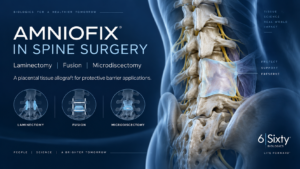
Bone graft technologies, extracellular matrix products, placental tissues, and other biologic materials are used across different areas of spine surgery.
Colorectal and General Surgery
Biologic technologies have been investigated and used in surgical settings involving bowel, abdominal reconstruction, complex wounds, and tissue repair.
Urologic Surgery
Reconstructive and tissue-focused applications have created interest in biologic materials within urologic procedures.
Neurosurgery
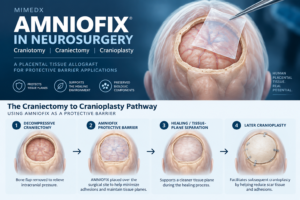
Dural repair, spine procedures, nerve-related applications, and complex tissue reconstruction represent areas where biologic technologies may be encountered.
Plastic and Reconstructive Surgery
Plastic surgery has long incorporated biologically derived tissues and matrices in procedures involving reconstruction, wound management, flaps, soft tissue, and complex surgical defects.
As research and technology continue to evolve, additional surgical specialties are likely to evaluate biologic solutions.
What Should Surgeons Consider When Evaluating Surgical Biologics?
Because the category is broad, simply asking whether a product is a “biologic” is not enough.
Clinicians and healthcare organizations may want to evaluate:
1. What is the biologic source?
Is the product derived from:
- Placental tissue?
- Collagen?
- Bone?
- Dermis?
- Another human tissue?
- Animal-derived tissue?
2. How is the material processed?
Processing can influence structure, preservation, sterility, handling, and other characteristics.
3. What exactly is in the product?
Products that sound similar can contain very different tissue components.
4. What is the intended surgical role?
Is the technology a barrier, scaffold, graft, matrix, filler, bone graft, or another type of surgical adjunct?
5. What clinical evidence exists?
Evidence should be evaluated for the specific product and application, rather than assumed from the broader biologic category.
6. What does the product labeling say?
Current manufacturer labeling and Instructions for Use should always be reviewed.
7. What are the storage and handling requirements?
Some biologics require refrigeration or freezing, while others are shelf stable.
8. What sizes or configurations are available?
The geometry and dimensions of the product may matter significantly in surgery.
9. What regulatory framework applies?
Different biologic technologies may fall under different regulatory pathways depending on the product, processing, intended use, and other factors.
How Are Human Tissue Products Regulated?
Human tissue technologies occupy an important regulatory environment.
The U.S. Food and Drug Administration regulates human cells, tissues, and cellular and tissue-based products, commonly referred to as HCT/Ps, under applicable federal regulations.
Those regulations address issues such as:
- Donor eligibility
- Communicable disease testing
- Tissue establishment registration
- Processing
- Manufacturing practices
- Recordkeeping
- Product classification
The exact regulatory pathway can vary depending on how a product is processed, its intended use, and whether it meets applicable criteria under federal regulations.
For that reason, clinicians and healthcare organizations should evaluate the regulatory status of the specific product, rather than assuming that every biologic technology fits within the same regulatory category.
Are Amniotic Grafts Surgical Biologics?
Yes.
Amniotic grafts and placental tissue allografts are one important segment of the broader surgical biologics landscape.
Products such as MiMedx AMNIOFIX and AMNIOEFFECT are examples of placental tissue technologies used within surgical environments.
However, surgical biologics extend well beyond amniotic tissue.
The category also encompasses bone graft technologies, collagen products, extracellular matrix materials, and many other biologically derived technologies.
Why the Surgical Biologics Category Matters
The development of surgical biologics reflects a broader shift in how the surgical community thinks about healing.
Historically, innovation focused heavily on:
- Better instruments
- Better implants
- Better visualization
- Smaller incisions
- Robotics
- Navigation
- Fixation
- Surgical technique
Those advances remain critical.
But another question is increasingly being asked:
What can be done to optimize the biological environment surrounding the surgical repair?
That question creates an enormous field for innovation.
The future of surgical biologics may involve increasingly sophisticated technologies designed around:
- Tissue protection
- Extracellular matrix
- Scaffolding
- Regeneration
- Reconstruction
- Inflammation
- Fibrosis
- Adhesion formation
- Bone healing
- Soft-tissue repair
- Wound management
Not every technology will be appropriate for every application, and clinical evidence will remain essential.
But the broader direction is clear: biology is becoming an increasingly important part of surgical innovation.
Surgical Biologics and the Future of Surgery
Surgery has undergone several major technological revolutions.
Minimally invasive surgery transformed access.
Robotics transformed precision.
Advanced imaging and navigation transformed visualization.
Next-generation implants transformed reconstruction.
Surgical biologics may represent another important layer of that evolution — focusing innovation on the biological environment surrounding surgery and recovery.
As manufacturers develop new technologies and clinical evidence expands, surgeons will have more biologic tools available to evaluate alongside traditional surgical techniques and implants.
That makes education increasingly important.
Understanding what a biologic contains, how it is processed, what evidence supports it, and where it fits within surgical care will be critical as the category grows.
Frequently Asked Questions About Surgical Biologics
What are surgical biologics?
Surgical biologics are biologically derived materials or technologies used within surgical care. The category can include tissue allografts, placental tissues, extracellular matrix products, collagen-based technologies, bone graft materials, and other biologically derived products.
Are amniotic grafts surgical biologics?
Yes. Amniotic grafts and placental tissue allografts are commonly included within the broader surgical biologics category.
What companies manufacture surgical biologics?
Many companies participate in different segments of the market. MiMedx, for example, specializes in placental tissue technologies and markets surgical products including AMNIOFIX and AMNIOEFFECT.
What is the difference between a biologic and an implant?
Traditional implants often provide mechanical or structural functions. Biologic technologies are derived from biological materials and are generally designed for roles involving tissue, scaffolding, barriers, grafting, reconstruction, or the biological surgical environment. Some procedures may use both.
Are all surgical biologics regulated the same way?
No. Regulatory pathways can vary significantly depending on the type of product, source material, processing, intended use, and other factors.
Are all amniotic grafts the same?
No. Amniotic and placental tissue products can differ substantially in tissue composition, processing, preservation, sterilization, thickness, handling, storage requirements, labeling, and clinical evidence.
Building a Better Understanding of Surgical Biologics
As the field grows, 6|Sixty Biologics is building an educational resource designed to help surgeons, healthcare professionals, and industry participants better understand emerging biologic technologies.
Topics in the growing 6|Sixty Biologics Insights library include:
- What are amniotic grafts?
- How amniotic grafts are used in OB-GYN surgery
- What is MiMedx AMNIOFIX?
- MiMedx AMNIOFIX vs. AMNIOEFFECT
- Placental tissue allografts
- Amnion vs. chorion
- Surgical biologics across individual surgical specialties
The objective is simple:
Make complex biologic technologies easier to understand and evaluate.
About 6|Sixty Biologics
6|Sixty Biologics is a surgical biologics specialist focused on connecting surgeons and healthcare organizations with advanced biologic technologies across multiple surgical specialties.
Our focus includes amniotic grafts, placental tissue allografts, extracellular matrix technologies, and other emerging surgical biologics designed for use within the surgical environment.
6|Sixty works with leading biologics manufacturers, including MiMedx, while providing clinical education, market access, and experienced surgical representation.
Through a growing national network, 6Sixty Biologics is focused on advancing education and access within the rapidly evolving field of surgical biologics.
References and Additional Information
U.S. Food and Drug Administration — Tissue & Tissue Products
Information regarding FDA regulation of human cells, tissues, and cellular and tissue-based products (HCT/Ps).
U.S. Food and Drug Administration — Regulatory Considerations for HCT/Ps
Guidance regarding minimal manipulation and homologous use considerations for human cells and tissues.
MiMedx — AMNIOFIX
Manufacturer information regarding AMNIOFIX placental tissue allograft.
MiMedx — AMNIOEFFECT
Manufacturer information regarding AMNIOEFFECT placental tissue allograft.
MiMedx — Placental Tissue Processing
Manufacturer information regarding MiMedx placental tissue processing technologies.
Important Information
This article is provided for educational purposes only and is not intended to provide medical advice or recommend any specific product or procedure.
Product selection and use are clinical decisions that should be made by qualified healthcare professionals after reviewing current manufacturer labeling, Instructions for Use, regulatory information, institutional requirements, individual patient circumstances, and applicable clinical evidence.
6|Sixty Biologics is an independent surgical biologics distributor and is not MiMedx. AMNIOFIX®, AMNIOEFFECT®, PURION®, and MiMedx are trademarks or trade names of MiMedx Group, Inc.