Amniotic grafts are human tissue allografts derived from placental tissue donated following healthy childbirth. These biologic tissues have a long history of clinical use and continue to be studied across a growing range of medical and surgical applications.
Today, advances in tissue recovery, processing, preservation, and sterilization have made amniotic tissue available to surgeons in a variety of configurations and sizes.
But what exactly is an amniotic graft, what makes this tissue unique, and how does it fit into the broader field of surgical biologics?
What Is the Amniotic Membrane?
The placenta is a temporary organ that supports fetal development during pregnancy. Associated placental membranes include two primary fetal membrane layers: the amnion and the chorion.
The amnion is the innermost membrane surrounding the developing fetus. It is a thin, strong, flexible tissue composed of several structural layers, including:
- An epithelial layer
- A basement membrane
- Stromal layers containing extracellular matrix
The chorion lies outside the amnion and has a different structure and composition.
Together, these tissues create a protective membrane system during pregnancy.

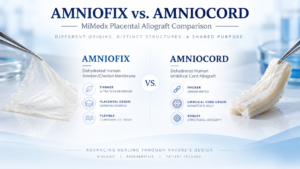
The amnion and chorion are distinct placental membrane layers that may be processed individually or together in placental tissue allografts.
What Is an Amniotic Graft?
An amniotic graft is an allograft manufactured from donated human placental tissue.
Following donation, qualified tissue banks recover and process the tissue according to applicable standards and regulatory requirements. Depending on the specific product and manufacturing process, an allograft may contain:
- Amnion
- Chorion
- Amnion and chorion
- Multiple layers of placental membrane
- Other birth-tissue components in certain products
The tissue may also be preserved using different techniques, including dehydration or cryopreservation.
These differences matter.
The term “amniotic graft” does not describe one standardized product. Tissue composition, processing methods, preservation techniques, thickness, handling characteristics, sterilization methods, and intended uses can vary substantially among commercially available allografts.
For surgeons and healthcare facilities evaluating an amniotic allograft, understanding the specific product is therefore just as important as understanding the tissue category itself.
Why Is Amniotic Tissue of Interest in Surgery?
Amniotic membrane has a unique structural and biological composition that has made it an area of interest in medicine for more than a century.
One important characteristic is its extracellular matrix, the structural framework surrounding cells within tissue. Amniotic membrane also contains naturally occurring proteins, cytokines, growth factors, and other biological components that have been the subject of extensive scientific research.
Researchers have studied amniotic membrane in areas involving tissue repair, wound management, reconstruction, and a variety of surgical applications.
However, biological characteristics demonstrated in laboratory research or with one specific amniotic product should not automatically be assumed to apply to every commercially available graft.
Processing matters, preservation matters, and the clinical evidence supporting an individual product matters.
Amnion vs. Chorion: What Is the Difference?
Although the terms are sometimes used together, the amnion and chorion are separate tissue layers.
Amnion
The amnion is the innermost fetal membrane. It is relatively thin and includes a prominent basement membrane and stromal extracellular matrix.
Chorion
The chorion is located outside the amnion and is generally thicker. Its cellular and extracellular composition differs from that of the amnion.
Commercial placental tissue grafts may use amnion alone, chorion alone, or combinations of the two.
This is one reason surgeons should look beyond the general term “amniotic graft” and understand the actual composition of the product being considered.
How Are Amniotic Grafts Processed?
Processing varies by manufacturer and product.
After recovery, placental tissue is generally cleaned and prepared before being preserved in a form suitable for storage and clinical use. Depending on the product, processing may include separation of tissue layers, cleansing, dehydration, cryopreservation, lamination, or additional manufacturing steps.
Different processing techniques can influence characteristics such as:
- Tissue architecture
- Thickness
- Strength
- Flexibility
- Handling
- Storage requirements
- Shelf life
- Retention of native tissue components
Some products are stored at room temperature, while others require refrigerated or frozen storage.
Sterilization approaches may also differ among products.
Because there is no single universal method for producing an amniotic allograft, surgeons and healthcare facilities should evaluate the characteristics, labeling, supporting evidence, and intended use of each individual product.
How Are Amniotic Grafts Used in Surgery?
Placental and amniotic tissues have been investigated in a broad range of medical and surgical fields.
Published literature has described applications involving specialties such as:
OB-GYN
Amniotic membrane has been studied in gynecologic and reproductive surgical settings, including procedures involving tissue reconstruction and healing.
Gastrointestinal and Colorectal Surgery
Researchers have investigated amniotic tissues in gastrointestinal surgery and applications involving surgical repair and reconstruction.
Orthopedic Surgery
Amniotic membrane and related placental tissues have been evaluated in orthopedic applications involving tendons, soft tissue, and musculoskeletal repair.
Urology
Placental tissue technologies have also been investigated in reconstructive and other urologic applications.
Neurosurgery
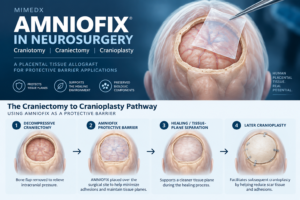
Published research includes investigation of amniotic membrane in certain neurosurgical and nerve-related applications.
Plastic and Reconstructive Surgery
Amniotic tissue has a long history of investigation in wound coverage, soft-tissue reconstruction, burns, and other reconstructive applications.
The clinical evidence, regulatory status, product labeling, and appropriate use can differ significantly by product and procedure. Clinicians should therefore evaluate the evidence and instructions associated with the specific allograft being considered.
Not All Amniotic Grafts Are the Same
This may be one of the most important concepts for clinicians new to placental tissue allografts.
Two products described broadly as “amniotic grafts” can be quite different.
Important variables can include:
Tissue composition
Is the product amnion-only, chorion-only, amnion-chorion, multilayer, or another placental tissue configuration?
Processing method
How is the recovered tissue cleaned, prepared, and processed?
Preservation
Is the graft dehydrated, cryopreserved, or preserved through another method?
Sterilization
What sterilization process, if any, is used?
Thickness and handling
Does the graft provide the handling characteristics appropriate for the intended surgical application?
Available sizes
Is the graft available in dimensions appropriate for the procedure?
Storage and shelf life
Does it require frozen storage, refrigeration, or room-temperature storage?
Clinical evidence
What peer-reviewed, preclinical, and clinical research exists for the specific tissue or product?
Regulatory and labeling considerations
What does the product’s labeling state regarding its processing and intended use?
Evaluating these differences provides a much more useful comparison than simply asking whether one product or another is an “amniotic graft.”
What Should Surgeons Consider When Evaluating an Amniotic Allograft?
When assessing an amniotic or placental tissue allograft, clinicians and healthcare organizations may want to consider several questions:
- What tissue does the graft contain?
- How is the tissue processed and preserved?
- How is the product sterilized?
- What sizes and configurations are available?
- How is the graft stored?
- How does it handle in the surgical environment?
- What scientific and clinical evidence supports the product?
- What does the product labeling indicate about its intended use?
- What tissue-bank, donor-screening, and quality standards apply?
These questions become increasingly important as the number and variety of placental tissue technologies continue to expand.
Amniotic Grafts and the Broader Field of Surgical Biologics
Amniotic allografts are part of a much larger and rapidly evolving field of surgical biologics.
Surgical biologics encompass biologically derived materials and technologies used within the surgical environment. Depending on the category, these technologies may include placental tissues, extracellular-matrix technologies, collagen-based products, bone graft materials, cellular or tissue-based products, and other biologic approaches.
The field reflects an important evolution in surgery: increasing attention not only to the mechanical completion of a procedure, but also to the biological environment in which tissue repair and recovery occur.
As research continues and technologies evolve, surgeons will have an expanding range of biologic options to evaluate.
Understanding the underlying tissue, processing methods, scientific evidence, regulatory framework, and product-specific characteristics will remain essential.
Frequently Asked Questions About Amniotic Grafts
Where do amniotic grafts come from?
Amniotic grafts are derived from donated human placental or birth tissue recovered following childbirth. Tissue donation, donor eligibility, testing, recovery, processing, and distribution are subject to applicable requirements and standards.
Are amnion and chorion the same tissue?
No. They are distinct placental membrane layers. The amnion is the innermost fetal membrane, while the chorion lies outside the amnion.
Are all amniotic grafts the same?
No. Products can differ in tissue composition, processing, preservation, sterilization, thickness, handling characteristics, storage, available sizes, supporting evidence, and labeling.
What is an amnion-chorion graft?
An amnion-chorion graft contains both amniotic and chorionic membrane tissue. Depending on the manufacturer, the layers may be processed and configured in different ways.
Are amniotic grafts considered surgical biologics?
Amniotic and placental tissue allografts are commonly discussed within the broader surgical biologics landscape because they are biologically derived tissue technologies used in clinical and surgical settings.
Continuing Education in Surgical Biologics
The science and clinical application of surgical biologics continue to evolve.
Future articles in the 6|Sixty Biologics Insights series will explore topics including:
- Amnion vs. chorion
- How placental tissue allografts are processed
- Amniotic grafts in OB-GYN surgery
- Amniotic grafts in colorectal surgery
- Amniotic grafts in urologic surgery
- Amniotic grafts in orthopedic surgery
- Surgical adhesions and fibrosis
- How surgeons can evaluate different biologic technologies
About 6|Sixty Biologics
6|Sixty Biologics is a surgical biologics specialist focused on connecting surgeons and healthcare organizations with advanced biologic technologies across multiple surgical specialties.
Through clinical education, experienced surgical representation, and collaboration with leading biologics manufacturers, 6|Sixty is helping expand access to emerging technologies designed for the surgical environment.
Learn more about 6|Sixty Biologics → https://6sixty.com
References
- The Preparation and Clinical Efficacy of Amnion-Derived Membranes: A Review. Published in 2023 and indexed by PubMed/PMC.
- Biological Properties and Surgical Applications of the Human Amniotic Membrane. A review of amniotic membrane characteristics and reported applications across multiple surgical specialties.
- U.S. Food and Drug Administration. Regulatory Considerations for Human Cells, Tissues, and Cellular and Tissue-Based Products: Minimal Manipulation and Homologous Use.
- U.S. Food and Drug Administration. Tissue & Tissue Products — Human Cells, Tissues, and Cellular and Tissue-Based Products (HCT/Ps).
This material is provided for educational purposes and is not intended to provide medical advice or to establish the appropriate use of any specific product. Clinicians should review applicable product labeling, regulatory information, institutional requirements, and available clinical evidence when evaluating individual biologic technologies.